Table of Contents
- Why Choose Locally Owned Health Stores in 2026
- The Local Economy Effect: Where Your Grocery Dollars Land
- The Importance of Organic Grocery Shopping for Everyday Health
- How to Choose High Quality Supplements at a Local Store
- Benefits of Natural Vitamin Supplements You Can Feel
- Personalized Guidance and Community Wellness Events
- Affordability Myths About Shopping Local
- Conclusion
- Frequently Asked Questions
Last Updated: September 30, 2026
Why Choose Locally Owned Health Stores in 2026
Eighty percent of consumers say they will pay more for local food, and the average shopper accepts a 9.7% premium to get it, according to Local Express food retailer growth statistics. That number explains a quiet shift happening in how households buy groceries and supplements. Choosing locally owned health stores is no longer just a values statement. It is a practical decision about freshness, advice, and where your money goes after the till closes.
This guide from Ambrosia Natural Foods walks through seven real benefits, from nutrient density to supplement label literacy. Below, we break down what actually changes when you shop local instead of defaulting to a big-box aisle.
The Local Economy Effect: Where Your Grocery Dollars Land
Money spent at an independent retailer recirculates through the community at a higher rate than money spent at a national chain. Locally owned, mission-driven stores act as community hubs that shape public health, local economics, and neighborhood stability, according to a systematic review of corner stores as community hubs.
That effect compounds. A store that hires locally, sources from nearby growers, and sponsors community events keeps more value in circulation. Research from Healthy Eating Research on healthy community stores found that locally owned stores improve healthy food access by adapting to specific neighborhood needs, something a national chain's central buying plan rarely allows.
The Importance of Organic Grocery Shopping for Everyday Health
Organic grocery shopping is the practice of buying food grown without synthetic pesticides or fertilizers, and it matters most for the items your household eats daily. Produce, grains, and pantry staples make up the bulk of most grocery baskets, so small sourcing decisions add up fast.
Freshness, Traceability, and What's Actually on the Label
Shorter supply chains mean less time between harvest and shelf. Local producers often harvest at peak ripeness, which supports nutrient density and flavor that long-haul produce struggles to match. Traceability improves too: a local store can usually tell you which farm grew your greens and when they arrived.
The practical test is simple. Ask where the produce came from. A store that answers without checking a central database is a store with real supply chain transparency.
How to Choose High Quality Supplements at a Local Store
Choosing high quality supplements comes down to three checks: the product license number, the ingredient panel, and whether anyone on staff can explain the formula. A trained staff member will walk you through all three in a few minutes.
Reading NPN Numbers and Product Labels
In Canada, natural health products carry a Natural Product Number (NPN) issued by Health Canada, which confirms the product has been reviewed for safety, quality, and claimed use. If a bottle has no NPN or DIN-HM, treat that as a red flag.
- Check the NPN or DIN-HM on the label
- Read the medicinal ingredients and their exact amounts
- Look for a clear dosage and a full caution section
- Confirm the expiry date and storage instructions
A local health store can point you to products that meet these standards.
Benefits of Natural Vitamin Supplements You Can Feel
The benefits of natural vitamin supplements show up in everyday energy, recovery, and digestion rather than dramatic overnight change. Magnesium supports muscle and nerve function, while probiotic blends support gut flora balance.
Personalized Guidance and Community Wellness Events
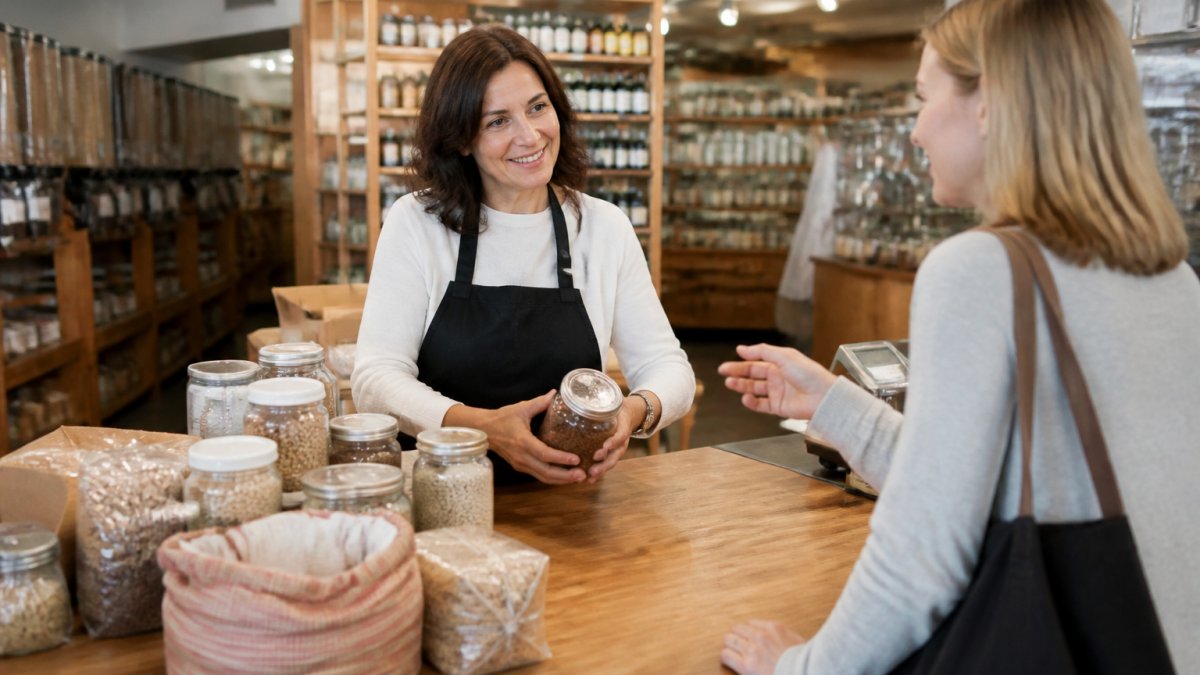
Personalized guidance is the single biggest advantage a local health store holds over an online order, and it is the gap most 'buy local' articles never address. Staff who know the product range can match a formula to your diet, your medications, and your goals in one conversation, something a warehouse aisle or a search filter cannot replicate.

What Personalized Guidance Actually Looks Like
A useful in-store consultation follows a repeatable pattern rather than a sales pitch:
- Intake questions first. Staff ask about current medications, existing supplements, dietary pattern, and specific goals before recommending anything.
- Interaction checks. Certain natural health products can interact with prescription drugs, so a trained staff member flags combinations worth discussing with a pharmacist or physician.
- Form and dose matching. The same nutrient can come as a capsule, powder, liquid, or fermented blend; guidance narrows the format to what you will actually take consistently.
- Follow-up. Because you return to the same store, staff can ask how a product worked and adjust the recommendation instead of starting over.
Community Wellness Events as a Health Resource
Many independent stores run workshops, tasting events, and nutrition talks that turn a routine errand into a learning opportunity. Common formats include:
- Cooking and meal-prep classes built around seasonal produce and pantry staples.
- Supplement literacy sessions that walk through how to read an NPN, an ingredient panel, and a dosage table.
- Guest practitioner talks on topics like gut health, sports recovery, or stress management.
- Tasting tables that let you try a product before committing to a full size.
Why This Matters for a Health Routine
Health routines fail for boring reasons: the product did not suit you, the dose was wrong, or nobody followed up. A local store closes those gaps through conversation and programming. That is the part of shopping local that no shipping threshold can replace.
Affordability Myths About Shopping Local
The assumption that local always costs more does not hold up, but the reason is more specific than most articles admit. A bulk-buying model lets a store negotiate volume pricing and pass the savings to customers. The real cost driver is not the store, it is how you shop it.
Where the 'Expensive' Reputation Comes From
Three habits make local health stores feel pricier than they are:
- Buying single small sizes. A small bottle of a supplement costs more per dose than a larger format of the same product.
- Shopping off-season. Out-of-season produce is imported, and imported produce carries the food miles and handling costs that seasonal local produce avoids.
- Buying one-off specialty items. A single niche product bought in isolation rarely benefits from volume pricing.
Practical Ways to Bring the Cost Per Serving Down
- Buy staples in larger sizes. Grains, legumes, nuts, seeds, and pantry oils keep well and cost less per serving in bulk.
- Shop seasonal produce. Buying what is actually in season locally reduces both price and food miles.
- Consolidate your list. One-stop shops carry groceries, supplements, and natural beauty, so a single trip replaces several errands.
- Use the store's own shipping threshold. Free shipping on qualifying orders removes the delivery cost that online orders often add back at checkout.
- Ask about house-recommended items. Staff often know which comparable products deliver the best value per dose.
| Myth | What Actually Happens | How to Save |
|---|---|---|
| Local is always pricier | Bulk buying narrows the gap | Buy staples in larger sizes |
| Selection is limited | One-stop shops carry groceries, supplements, beauty | Consolidate your list |
| Online is cheaper | Shipping and returns add cost | Use free shipping thresholds |
| Quality is unverified | NPN numbers confirm review | Check the label every time |
| Seasonal produce is scarce | Local harvests peak in season | Plan meals around what is fresh |
The Long-Term Math
A supplement that suits you on the first try costs less than three that do not. That is the affordability argument most comparisons miss: the value of a local health store is not a lower sticker price on every item, it is fewer wasted purchases because someone helped you choose correctly. Ambrosia Natural Foods has run on this model since 1979, combining organic groceries, supplements, and natural beauty in one stop, with free shipping on orders of $79.99 or more.
Conclusion
The case for shopping local rests on more than sentiment. It rests on fresher food, verified supplements, and advice you cannot get from a warehouse aisle. If you want organic groceries, natural vitamins, and beauty products in one place, Ambrosia Natural Foods offers a bulk-buying model, Canada-wide delivery, and free shipping on orders over $79.99. Get started with Ambrosia Natural Foods and stock your household at the lowest possible prices.
Frequently Asked Questions
What are the benefits of shopping at a locally owned health store?
You get fresher food, staff who know the products, and money that stays in your community. Locally owned, mission-driven stores are effective at improving healthy food access because they adapt to specific local needs. They also act as community hubs that support public health and local economic stability. At Ambrosia Natural Foods, that has meant one-stop shopping for organic groceries, supplements and natural beauty since 1979.
Are locally owned health stores more expensive than big chains?
No! Bulk-buying models push real prices down further by passing volume savings to shoppers. Ambrosia Natural Foods uses exactly this approach, so a 120-capsule bottle of Magnesium Bis-Glycinate 200 is $24.99 and free shipping starts at $79.99. Compare unit prices, not shelf tags.
How do I know the supplements at a local store are high quality?
Check for a Natural Product Number (NPN) on the label, which shows the product was reviewed under Canada's Natural Health Products Regulations. Then read the medicinal ingredients panel: dose, form, and source all matter. For example, Magnesium Bis-Glycinate 200 lists 200 mg of magnesium per capsule, and Your Flora Terrain names its Kefi-Soy fermented soybean dose at 133.3 mg. Ask staff to walk you through the label before you buy.
How does shopping at a local health store impact the community?
Independent grocers strengthen civic life and adapt quickly to local needs. Community wellness events, nutrition talks, and one-on-one guidance are part of that same picture. Spending locally keeps those services funded and keeps food dollars circulating close to home.